
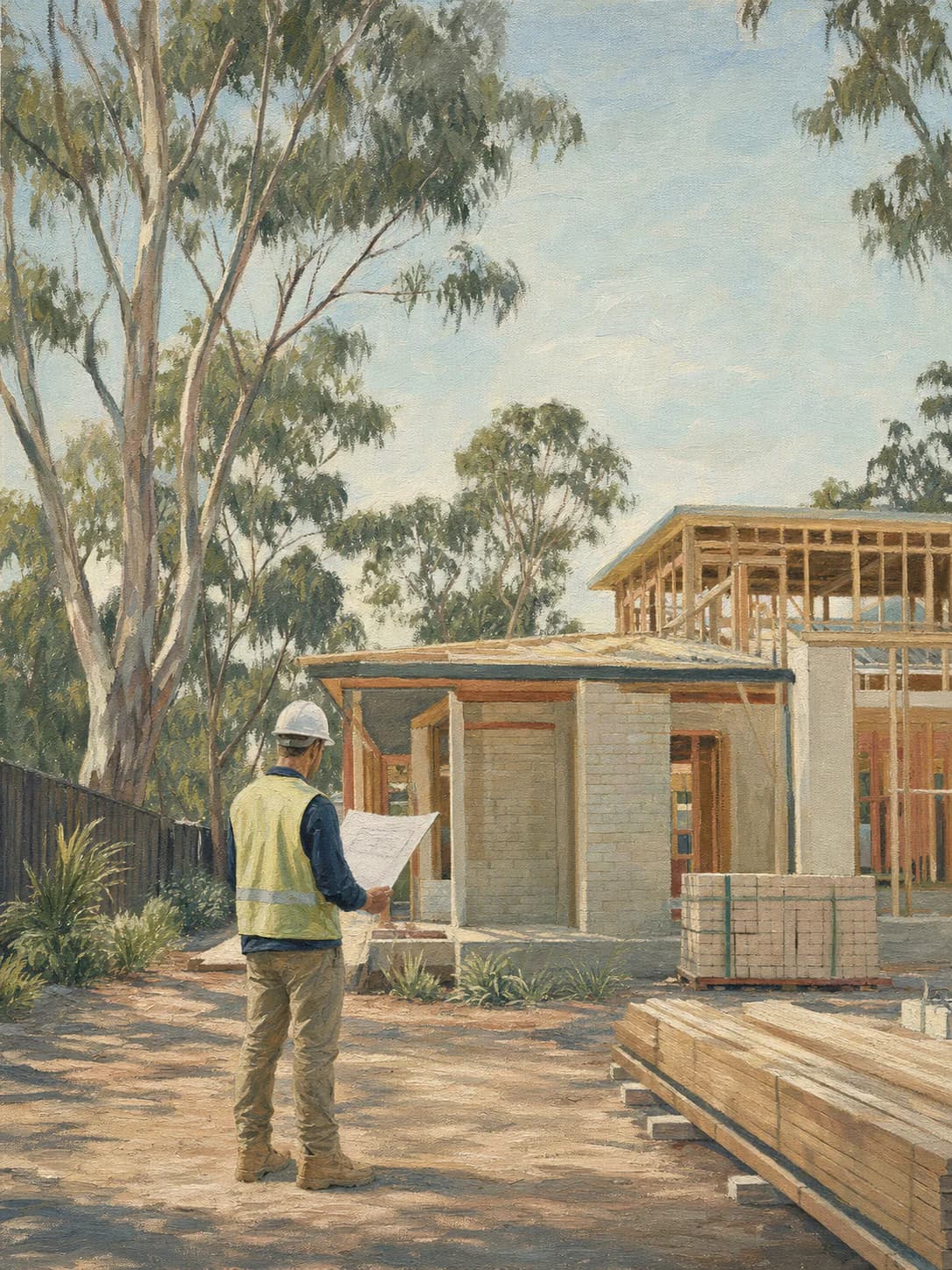
Construction businesses lose time when project information is spread across inboxes, phones, shared drives and site systems. Automation can connect those records, prepare routine documents and keep exceptions visible without removing project accountability.
Industry signal
Construction has added roughly half a million workers in two decades.
Jobs and Skills Australia reports 1,371,500 construction workers in February 2026, up from 872,300 in February 2006. ASBFEO estimates small businesses employed 804,000 people in the industry in June 2024, highlighting the scale of coordination carried by smaller contractors and subcontractors.
How the work really moves
The expensive gaps occur between site evidence and commercial records.
A variation may begin as a verbal instruction, become a phone photo, require subcontractor pricing, and later need a formal notice, approval and claim line. When evidence is split across devices and inboxes, the commercial team reconstructs events after the fact.
AI can classify site evidence and draft a variation pack, but contract dates, notice requirements, rates and entitlement must come from controlled project records. The project manager should approve scope and price before client communication. Safety decisions and incidents must remain inside established safety systems and escalation procedures.
Manual work to inspect
Look for the handoffs people have learned to tolerate.
Tender intake
Downloading drawings and addenda, locating scope dates, building a submission checklist and tracking clarifications.
Variation documentation
Combining instructions, site diaries, photos, labour, materials, rates and approval history into a defensible record.
Progress claims
Checking milestones, quantities, supporting evidence, subcontractor claims and outstanding approvals each period.
Where AI can help
Use AI for interpretation. Use workflow rules for control.
Structure tender enquiries
Capture scope, dates, drawings and submission requirements before an estimator reviews the opportunity.
Prepare variation records
Organise site notes, photos, instructions and cost inputs into a consistent draft for approval.
Coordinate progress claims
Track supporting documents, milestones and outstanding approvals for each claim period.
A practical first workflow
Start with variation documentation
Bring site instructions, photos and cost inputs into one review flow. The system prepares a variation record and customer update, while the project manager approves scope and commercial details.
- 1
Resolve the project, location, instruction source and contract reference.
- 2
Collect dated photos, drawings, site notes and impacted work packages.
- 3
Request missing labour, material and subcontractor inputs.
- 4
Prepare a draft variation record and notice against approved templates.
- 5
Hold all external communication until commercial approval is recorded.
Systems to connect
Keep live facts in the systems that own them.
- Project management
- Site capture
- Document control
- Estimating and accounting
Human checkpoints
Make responsibility visible.
- Scope, entitlement, rates and contractual notice
- Safety, structural and compliance decisions
- Client commitment and claim submission
Measure the pilot
Prove that the workflow is better, not merely automated.
Time from site instruction to draft variation
Variations submitted with complete contemporaneous evidence
Unapproved work identified before commencement
Claim items delayed by missing documents
What good looks like
Clearer work, with people still in control.
- Clearer project records and audit trails
- Faster preparation of variations and claims
- Fewer missed approvals and supporting documents
A responsible 90-day path
Start narrow enough to learn from real exceptions.
Observe and baseline
Follow the current workflow end to end. Count volume, handling time, rework, wait time and the decisions that require accountable judgement.
Build a controlled pilot
Connect the minimum systems, use a limited data set, retain source evidence and place approval before every material action.
Compare and decide
Review errors and exceptions, compare the agreed measures, document operating ownership and expand only when the evidence supports it.
Frequently asked questions
Practical questions before you automate.
What is a sensible first AI automation for construction and subcontracting?
Start with variation documentation. Bring site instructions, photos and cost inputs into one review flow. The system prepares a variation record and customer update, while the project manager approves scope and commercial details.
Which existing systems usually need to connect?
A practical first pilot often connects Project management, Site capture, Document control, Estimating and accounting. Keep these systems as the source of truth and use AI to interpret information or prepare actions around them.
Which decisions should stay with people?
Keep accountable human review for scope, entitlement, rates and contractual notice; safety, structural and compliance decisions; client commitment and claim submission. Automation should make these checkpoints clearer, not remove them.
How should we measure whether the automation is working?
Record a baseline before the pilot, then compare time from site instruction to draft variation; variations submitted with complete contemporaneous evidence; unapproved work identified before commencement; claim items delayed by missing documents. Review errors and exceptions alongside any time saved.
Do we need to replace our current software first?
Usually not. A focused pilot can connect to the tools the business already uses, provided they offer reliable exports, APIs or controlled integration points. Replace a core system only when it is the actual constraint, not simply because an AI project has started.
How much should a construction and subcontracting business budget for AI automation?
There is no reliable fixed price without seeing the workflow. Budget around one measurable process, such as start with variation documentation, and include process discovery, integration, security controls, testing, model usage and ongoing support. Compare that total cost with the current volume, handling time, rework and missed opportunities before approving a larger rollout.
How long does a practical AI automation project take?
A focused project should be staged rather than promised as an instant transformation. Use the first 15 days to observe and baseline the work, the next 30 days to build a controlled pilot, and the remainder of a 90-day cycle to measure errors, adoption and business impact. Regulated or safety-critical workflows can require longer testing and approval.
How do I know whether my construction and subcontracting business is ready for AI?
Readiness starts with a repeated workflow that has a clear owner, enough volume to measure and reliable source information. Tender intake is one process worth observing. Before connecting AI, document the exceptions, decide who approves material actions, confirm vendor data-handling terms and record a baseline for quality, time and cost.
Sources and scope
Primary Australian data used in this guide.
Industry statistics provide context, not a forecast of savings. Automation outcomes depend on workflow volume, data quality, system access, controls and adoption inside each business.
Start with one useful workflow
See what AI automation could remove from your week.
We'll map the process, identify the right checkpoints and build a focused proof of concept.
Discuss your workflow