
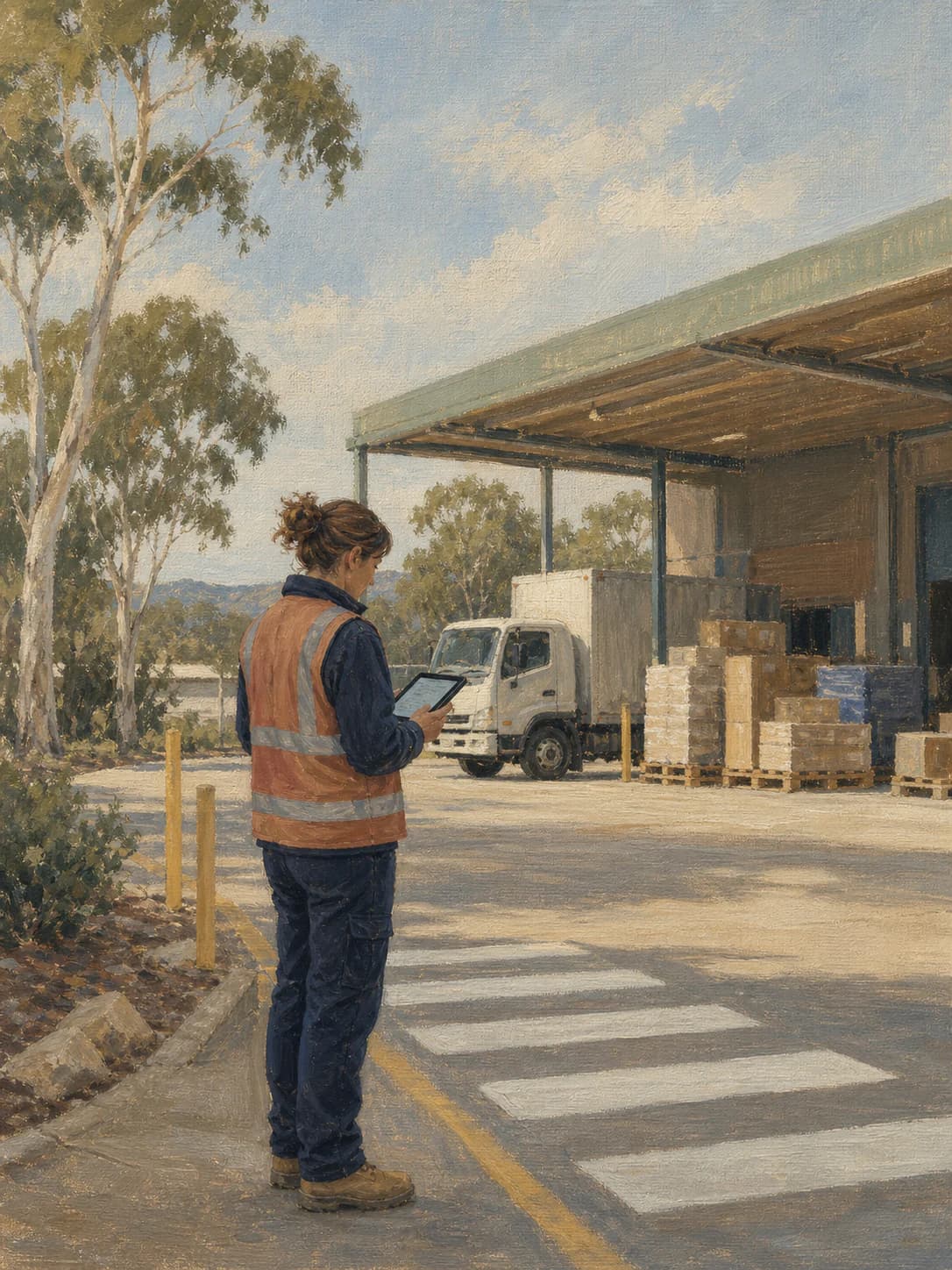
Transport teams work across tight schedules and many handoffs. AI automation can structure incoming requests, connect status updates and prepare customer communication while dispatchers remain in control of live operations.
Industry signal
The freight task is forecast to grow while every job still depends on accurate handoffs.
BITRE forecasts Australia's domestic freight task will grow 26% from about 756 billion tonne-kilometres in 2020 to 964 billion by 2050. Jobs and Skills Australia reports 754,500 people already work across transport, postal and warehousing.
The 2050 value is a BITRE forecast, not an observed result.
How the work really moves
Automation is most valuable at booking and exception boundaries.
A transport booking can arrive without a loading window, dimensions, dangerous-goods declaration, access instructions or reference. Dispatchers spend time resolving missing fields before they can make a safe operational decision. Later, customer service teams manually translate telematics and proof-of-delivery events into updates.
AI can structure booking documents and explain status, while a transport management system applies capacity, route and rate rules. Live routing, fatigue, load restraint, dangerous goods and weather disruptions require trained operational control. The system should surface exceptions, not disguise uncertainty.
Manual work to inspect
Look for the handoffs people have learned to tolerate.
Booking normalization
Translating emails and spreadsheets into pickup, delivery, freight, equipment, timing and reference fields.
Status communication
Checking dispatch, telematics, depot and carrier systems before answering routine location and ETA questions.
Proof-of-delivery matching
Connecting signatures, scans, photos and exceptions to the right consignment before invoicing.
Where AI can help
Use AI for interpretation. Use workflow rules for control.
Structure booking requests
Extract pickup, delivery, freight and timing details for validation before dispatch planning.
Prepare delivery updates
Draft customer notifications from confirmed milestones rather than manually checking multiple systems.
Organise proof of delivery
Match signed documents and photos to the correct job and flag missing records quickly.
A practical first workflow
Start with booking intake
Turn email and form requests into a consistent dispatch brief. Missing details are requested automatically, while unusual loads and timing conflicts are sent directly to a dispatcher.
- 1
Extract locations, windows, freight, quantity, dimensions and service level.
- 2
Validate addresses, customer references and mandatory declarations.
- 3
Ask for missing fields without creating a dispatch job prematurely.
- 4
Apply contracted service and rate rules in the transport system.
- 5
Route capacity, safety and timing conflicts to dispatch.
Systems to connect
Keep live facts in the systems that own them.
- Transport management
- Telematics
- Customer or carrier portal
- POD and accounting
Human checkpoints
Make responsibility visible.
- Fatigue, dangerous goods, load and route safety
- Live disruptions and promised delivery changes
- Rate exceptions, claims and damaged freight
Measure the pilot
Prove that the workflow is better, not merely automated.
Bookings complete before dispatch review
Manual keystrokes or touches per consignment
Routine status contacts resolved from live events
Invoices delayed by missing proof of delivery
What good looks like
Clearer work, with people still in control.
- Less re-keying between bookings and dispatch
- Faster customer status communication
- More complete delivery documentation
A responsible 90-day path
Start narrow enough to learn from real exceptions.
Observe and baseline
Follow the current workflow end to end. Count volume, handling time, rework, wait time and the decisions that require accountable judgement.
Build a controlled pilot
Connect the minimum systems, use a limited data set, retain source evidence and place approval before every material action.
Compare and decide
Review errors and exceptions, compare the agreed measures, document operating ownership and expand only when the evidence supports it.
Frequently asked questions
Practical questions before you automate.
What is a sensible first AI automation for transport and logistics?
Start with booking intake. Turn email and form requests into a consistent dispatch brief. Missing details are requested automatically, while unusual loads and timing conflicts are sent directly to a dispatcher.
Which existing systems usually need to connect?
A practical first pilot often connects Transport management, Telematics, Customer or carrier portal, POD and accounting. Keep these systems as the source of truth and use AI to interpret information or prepare actions around them.
Which decisions should stay with people?
Keep accountable human review for fatigue, dangerous goods, load and route safety; live disruptions and promised delivery changes; rate exceptions, claims and damaged freight. Automation should make these checkpoints clearer, not remove them.
How should we measure whether the automation is working?
Record a baseline before the pilot, then compare bookings complete before dispatch review; manual keystrokes or touches per consignment; routine status contacts resolved from live events; invoices delayed by missing proof of delivery. Review errors and exceptions alongside any time saved.
Do we need to replace our current software first?
Usually not. A focused pilot can connect to the tools the business already uses, provided they offer reliable exports, APIs or controlled integration points. Replace a core system only when it is the actual constraint, not simply because an AI project has started.
How much should a transport and logistics business budget for AI automation?
There is no reliable fixed price without seeing the workflow. Budget around one measurable process, such as start with booking intake, and include process discovery, integration, security controls, testing, model usage and ongoing support. Compare that total cost with the current volume, handling time, rework and missed opportunities before approving a larger rollout.
How long does a practical AI automation project take?
A focused project should be staged rather than promised as an instant transformation. Use the first 15 days to observe and baseline the work, the next 30 days to build a controlled pilot, and the remainder of a 90-day cycle to measure errors, adoption and business impact. Regulated or safety-critical workflows can require longer testing and approval.
How do I know whether my transport and logistics business is ready for AI?
Readiness starts with a repeated workflow that has a clear owner, enough volume to measure and reliable source information. Booking normalization is one process worth observing. Before connecting AI, document the exceptions, decide who approves material actions, confirm vendor data-handling terms and record a baseline for quality, time and cost.
Sources and scope
Primary Australian data used in this guide.
Industry statistics provide context, not a forecast of savings. Automation outcomes depend on workflow volume, data quality, system access, controls and adoption inside each business.
Start with one useful workflow
See what AI automation could remove from your week.
We'll map the process, identify the right checkpoints and build a focused proof of concept.
Discuss your workflow